People who say they are “not a math person” almost always stumbled on a step they left behind: a fraction they never really understood, a sign rule memorized without meaning, an equation solved by magic. Math is a staircase. Each topic rests on the one before, so starting from scratch is nothing to be ashamed of: it is the fastest way to get far.
This roadmap shows the order of topics, how to study each stage and four worked examples, step by step, the way you will practice them.
The roadmap in five stages
- Arithmetic and mental math. Addition, subtraction, multiplication, division and the order of operations. This is the foundation: if 7 × 8 slows you down, your attention goes to the arithmetic and the reasoning gets lost.
- Numbers: factors, fractions, decimals and percentages. Multiples and factors (LCM and GCD), equivalent fractions, operations with fractions, decimals and percentages.
- Ratios and everyday math. Ratios, proportions, simple and compound interest. This is where math starts solving real problems.
- Algebra. Linear equations, systems, special products, factoring and quadratic equations. A letter now stands for a number you do not know yet.
- Functions. The idea of a function, linear, quadratic and exponential functions, and logarithms. After that come statistics, probability, geometry and, for those who keep going, calculus.
Do not skip stages out of impatience. If a stage already feels easy, test yourself on it: getting a varied set of problems right is the green light to move on, not the feeling that “I have seen this before”.
Stage 1: mental math that builds confidence
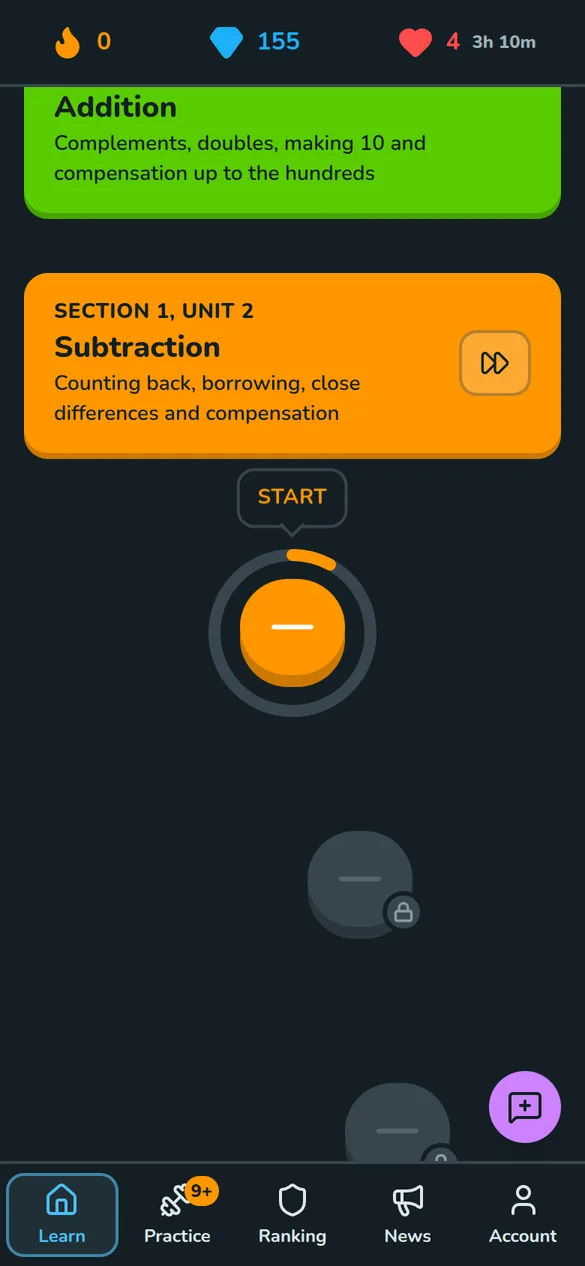
Mental math is not about memorizing tricks. It is about understanding how numbers break apart, and that shows up again in fractions, algebra and estimation. One of the most useful techniques is compensation: round one term to a nice round number, then undo the adjustment.
Worked example: 398 + 244
- 398 is 2 away from 400, a round number.
- Add using the round number: 400 + 244 = 644.
- You added 2 too many, so take them back: 644 − 2 = 642.
Check: with the standard algorithm, 8 + 4 = 12 (carry 1), 9 + 4 + 1 = 14 (carry 1), 3 + 2 + 1 = 6. Result: 642.
Stage 2: fractions without fear
A fraction is a division written another way: 3/4 is 3 divided by 4. The classic mistake is adding numerators to numerators and denominators to denominators. You can only add pieces of the same size, so first give the fractions a common denominator.
Worked example: 1/2 + 1/3
- The denominators are 2 and 3. The LCM of 2 and 3 is 6.
- Rewrite each fraction with denominator 6: 1/2 = 3/6 and 1/3 = 2/6.
- Now the pieces are the same size: 3/6 + 2/6 = 5/6.
Check: in decimals, 0.5 + 0.333… = 0.833…, and 5 ÷ 6 = 0.833…. The wrong shortcut would give 2/5 = 0.4, less than 1/2 on its own, which already gives the mistake away.
Stage 3: percentages and ratios
A percentage is a fraction with denominator 100. In your head, start from 10% (divide by 10) and 5% (half of 10%).
Worked example: 15% of 240
- 10% of 240 is 24.
- 5% is half of 10%: 12.
- 15% = 10% + 5%, so 24 + 12 = 36.
Check: 0.15 × 240 = 36.
Stage 4: your first equation
An equation is a balanced scale. Whatever you do to one side, you must do to the other. “Move it to the other side and flip the sign” is just a shortcut for that idea, and memorizing it without understanding is the source of many sign errors.
Worked example: 2x + 3 = 11
- Subtract 3 from both sides: 2x + 3 − 3 = 11 − 3, that is, 2x = 8.
- Divide both sides by 2: x = 4.
Check: substitute into the original equation: 2 · 4 + 3 = 8 + 3 = 11. It works.
How to study each stage
- A little, every day. Fifteen to twenty minutes a day beats three hours on Sunday, because memory consolidates between sessions.
- Practice right after the explanation. Reading a solution feels like understanding; only solving on your own shows whether you understood.
- Check another way. Every example above ends with a check. That habit catches mistakes before the exam does.
- Study the mistake, not just the right answer. When you get something wrong, redo the solution step by step and find the step where you went off track.
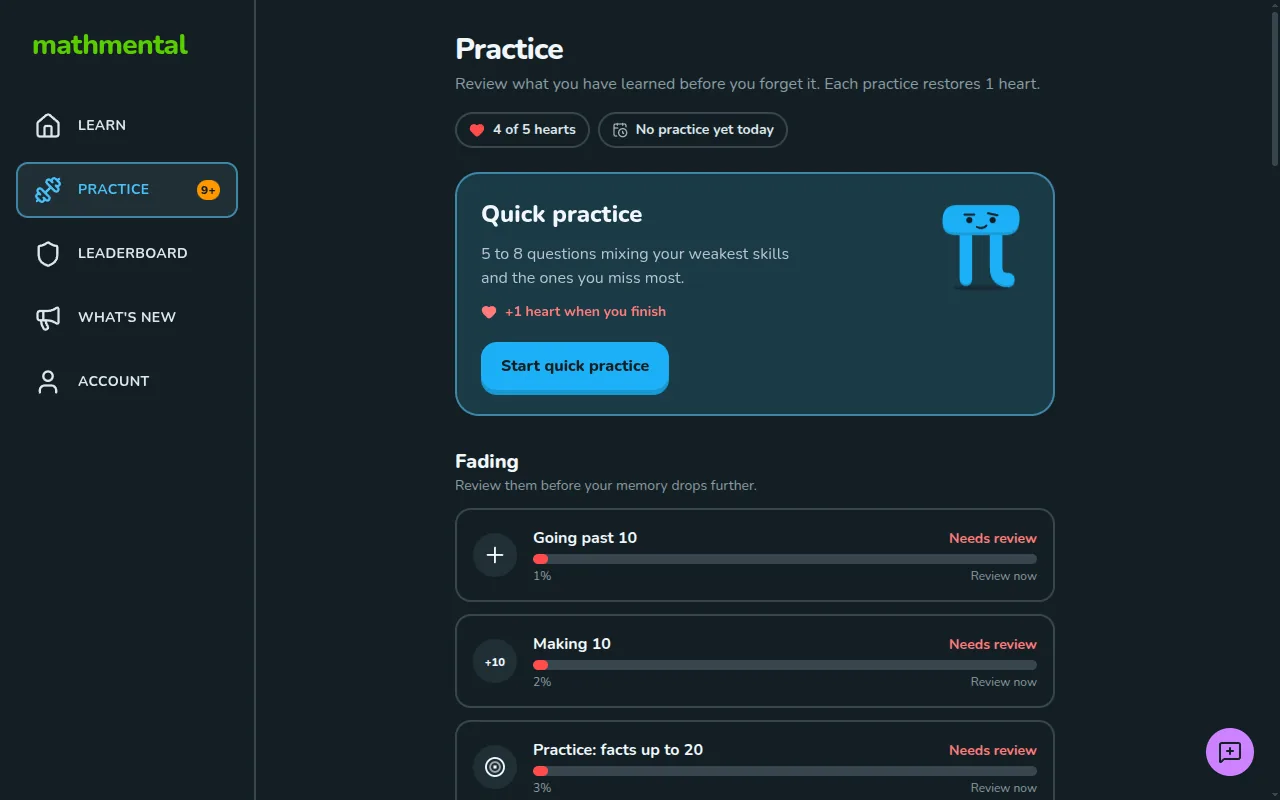
- Review before you forget. Material you do not use fades. Come back to it at growing intervals: the next day, a few days later, then weeks later.
Common mistakes when starting from scratch
- Skipping the basics because they look easy. Trouble with equations is often trouble with fractions or sign rules.
- Watching lessons without solving problems. Following an explanation and being able to do it are different skills.
- Memorizing rules without knowing where they come from. “Move it and flip the sign” turns into confusion once the equation has fractions or parentheses.
- Studying only what you already know. It is comfortable, but it does not move you forward. Spend part of your time on what you get wrong most.
- Giving up at the first mistake. Mistakes are part of training; what matters is understanding the step that failed.
How Math Mental organizes this roadmap
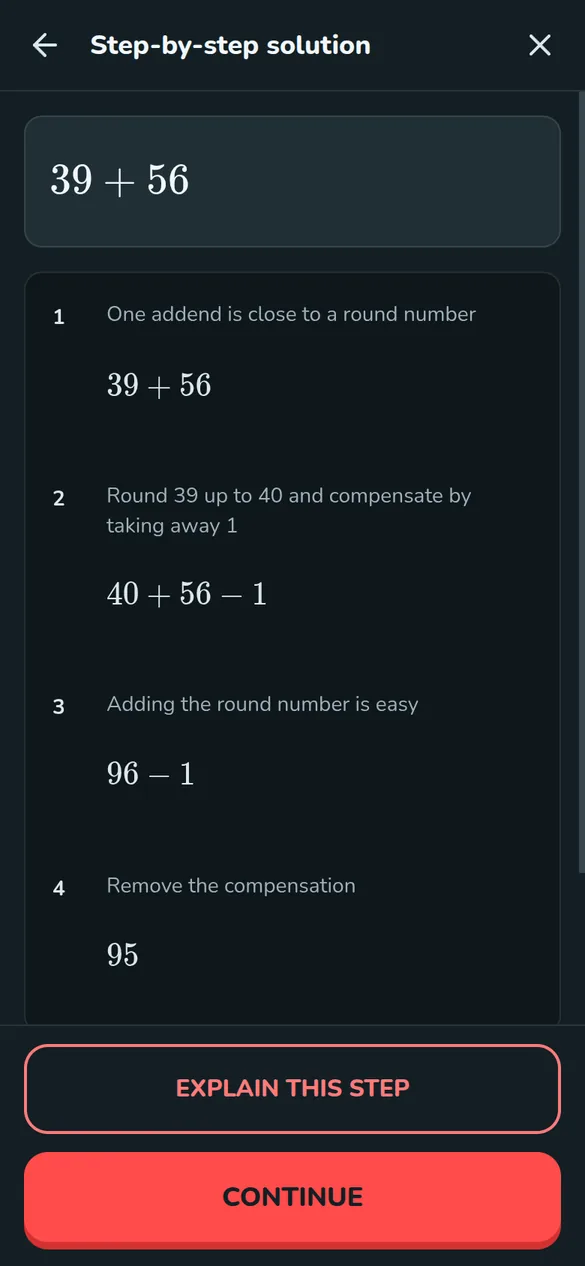
Math Mental turns these stages into a path of short lessons, from addition to calculus, with 82 units. Every missed question comes with a step-by-step solution showing the intermediate calculations, the Practice tab gathers what is fading and the questions you miss most, and if you already master a unit you can take the test to skip it. It works in the browser on your phone and computer, it is free and it has no ads.
Frequently asked questions
Where should I start learning math from scratch?
With the four operations and mental math. Then move on to fractions, decimals and percentages, ratios, equations and functions, in that order.
How much time should I study each day?
Fifteen to twenty minutes every day, with practice problems, usually pays off more than long, occasional sessions. Consistency is what matters.
Can an adult learn math from scratch?
Yes. The path is the same: start with the basics, practice every day and review what fades. The difference is that adults usually move faster through the early stages.
How do I know if I can skip a stage?
Solve a varied set of problems from that stage without looking anything up. If you get them right with confidence, move on; in Math Mental, the unit test does that check for you.